
The short answer
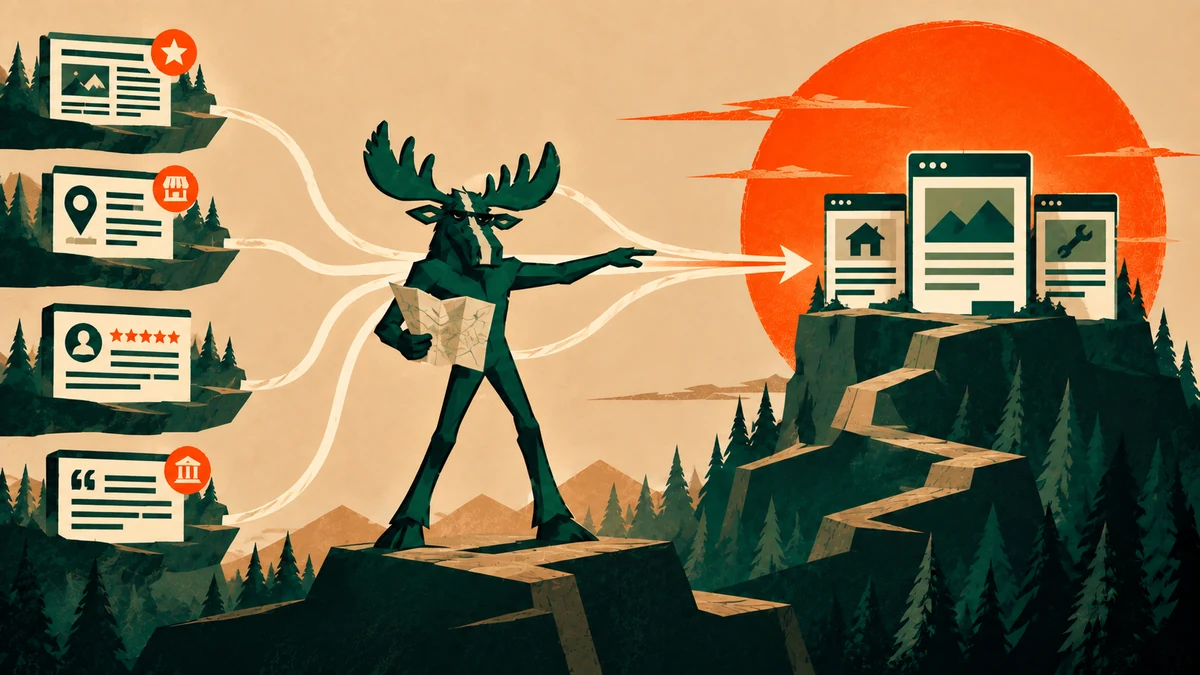
Off-page SEO makes real-world credibility legible online.
Off-page SEO for service businesses is not the purchase of links. It is a disciplined process for earning independent corroboration: relevant publications cite useful work, local organizations confirm participation, customers describe genuine experiences, and industry relationships create defensible mentions.
The working test is simple: can a person explain why this source mentioned this business, in this context, and sent the reader to this destination? If the answer depends on a package, quota, or hidden arrangement, the opportunity is probably weak.
The authority test
Judge every opportunity through six connected questions.
Prioritize the pipeline
Score expected value—not a vendor's metric.
Start with opportunities where relevance and a legitimate editorial reason are both high. Then consider audience usefulness, destination fit, likelihood, effort, and risk. Domain-level metrics can support investigation, but they cannot tell you whether a specific page, placement, or relationship makes sense.
| Opportunity | Best signal | Typical destination | Watch for |
|---|---|---|---|
| Trade contribution | Expertise | Guide or service | Paid guest-post inventory |
| Local project coverage | Geography + proof | Case study | Thin sponsor pages |
| Supplier relationship | Operational legitimacy | Relevant service | Sitewide boilerplate |
| Original data | Reference value | Research asset | Claims without method |
A practical first quarter
Build the reasons before scaling outreach.
- Weeks 1–2: inventory current mentions, referring sources, citations, reviews, partnerships, and pages receiving authority.
- Weeks 3–4: compare actual search competitors and classify recurring source patterns.
- Weeks 5–8: create or strengthen the destinations those sources would reasonably cite—proof, tools, studies, and expert guides.
- Weeks 9–12: pursue a short qualified list with personalized, contribution-led outreach; record outcomes and follow-on relationships.
Authority building works best when outreach is the final step in a real business story—not the first step in a link transaction.
From opportunity to authority
Authority work should leave behind evidence—not just a link count.
MooseRank's off-page SEO and authority building work evaluates the source, the reason for the mention, its context, the destination, the risk, and the business outcome as one system.
As a Long Island SEO company, MooseRank connects earned authority to the service and market pages customers actually need.
Build authority worth verifying
Pursue the sources that make the business easier to trust.
Bring the market, priority pages, current mentions, and competitor set. MooseRank will separate useful opportunities from noise and build a defensible campaign.
Straight answers
Common questions
01What is off-page SEO?+
Off-page SEO is the work of earning and managing credible signals about a business beyond its own pages. It can include editorial links, local and industry mentions, accurate citations, customer reviews, partnerships, and digital PR. The goal is not to manufacture popularity; it is to make genuine authority visible and verifiable.
02Are backlinks still useful for SEO?+
Links can help search systems discover pages and understand relationships, but not every link is useful. Relevance, editorial reason, context, destination, and risk matter more than a raw count or a third-party authority score.
03Should every backlink point to the homepage?+
No. The destination should be the page that best satisfies the reason for the mention. A trade guide may deserve a useful article, a local project story may support a case study, and a service recommendation may appropriately reach a service page.
04How is local authority different from general link building?+
Local authority often comes from organizations, publications, customers, suppliers, projects, and events connected to the real market. Geographic relevance can matter even when the source is not a globally famous website.
05How long does authority building take?+
Useful authority compounds over months because the work depends on real relationships, publishable assets, customer experiences, and editorial decisions. A campaign should track qualified opportunities and earned outcomes rather than promise a fixed number of links.
Primary sources
Documentation reviewed
- Google Search Essentials: spam policies
- Google Search Central: link best practices
- Google Search Central: qualify outbound links
- Google Search Central: creating helpful, reliable, people-first content
Research note: official documentation was reviewed September 22, 2026. MooseRank's frameworks are practical decision aids, not Google scoring systems or ranking guarantees.

About the author
The Moose
The Moose is the Founder of MooseRank and writes about SEO strategy, AI search visibility, and the evidence businesses should use to make better search decisions.
Meet The Moose and the MooseRank system