
Eligibility before optimization
A page must be accessible, indexable, useful, and technically retrievable before an AI search system can reliably consider it as a source.
The complete MOOSE campaign / System 05
Make your business easier for AI-driven search and answer platforms to discover, understand, cite, and recommend. MooseRank connects AI visibility to the technical, content, authority, and local signals that make a complete SEO campaign credible.
The shortcut problem
AI visibility cannot be created with a special file, keyword trick, or one-time schema change. Search eligibility, clear entities, useful evidence, and wider corroboration must work together.
A page must be accessible, indexable, useful, and technically retrievable before an AI search system can reliably consider it as a source.
Clear answers help, but original facts, named expertise, first-party proof, and corroboration give an answer platform a reason to trust them.
We test repeatable customer prompts, record citations and mentions, and connect referral activity to outcomes instead of claiming guaranteed LLM rankings.
What AI search optimization includes
AI search optimization is connected work. Access, entity clarity, answer quality, evidence, corroboration, and measurement must reinforce the same real business.
Review robots controls, index eligibility, rendered text, internal discovery, status codes, canonicals, and access for relevant search and AI retrieval crawlers.
Clarify the organization, people, services, locations, expertise, credentials, relationships, and consistent facts that identify the business across the web.
Create direct, specific, well-structured answers supported by useful service detail, comparisons, definitions, processes, examples, and expert context.
Strengthen original experience, named authorship, project evidence, statistics, policies, case material, and verifiable sources that make claims supportable.
Align reviews, citations, profiles, relevant links, brand mentions, local sources, and authoritative references so the wider web confirms the same entity.
Track a stable set of discovery and recommendation prompts, cited URLs, brand inclusion, accuracy, sentiment, referral traffic, assisted conversions, and qualified leads.
Where customers ask
Platforms retrieve and synthesize information differently. The durable approach is to strengthen the source, entity, and authority signals they can evaluate—not build a separate website for every model.
Build on Google Search eligibility, people-first usefulness, internal discovery, structured clarity, and the authority signals that support retrieval from the search index.
Keep public information accessible to search retrieval, clarify the business entity, and publish source-worthy pages that can be surfaced, cited, and linked.
Strengthen passage-level clarity, factual support, source relationships, freshness where it matters, and the external corroboration used in answer synthesis.
Create durable, platform-agnostic signals so the business remains understandable as interfaces, retrieval partners, models, and citation behavior change.
The visibility sequence
Make the source available. Clarify what the business is. Publish information worth retrieving. Build corroboration. Then test whether real customer prompts begin including the brand.

Campaign execution
Emerging Search is the fifth MOOSE system because it depends on the four beneath it. Market relevance, useful pages, external authority, and a stable technical foundation create the source environment AI discovery needs.
What the campaign produces
Every recommendation is tied to a discoverability constraint, entity ambiguity, missing answer, unsupported claim, corroboration gap, or measured opportunity—not a vague promise to “rank in AI.”
A defined prompt set by service, location, comparison, problem, and recommendation intent, with current mentions, citations, source URLs, accuracy, and competitor inclusion.
Search and AI crawler access, index eligibility, rendered content, internal discovery, canonical ownership, snippet controls, and technical constraints that affect source availability.
The business, people, services, locations, expertise, credentials, profiles, schema, and third-party references that should describe one consistent real-world organization.
Priority pages, direct-answer passages, expert contributions, original evidence, comparisons, definitions, FAQs, and supporting resources mapped to real customer questions.
Reviews, citations, relevant links, brand mentions, profiles, local sources, industry references, and digital PR opportunities that can validate important claims.
Prompt, platform, date, answer treatment, citation, cited URL, brand accuracy, competitor presence, referral activity, qualified outcome, and the next evidence-led action.
How progress is measured
Services, expertise, locations, proof, and brand relationships become easier for retrieval and answer systems to interpret.
Useful, extractable information and corroborating authority give AI platforms better reasons to use the business as a source.
Priority prompts, citations, brand mentions, referral traffic, and qualified outcomes replace unsupported claims about ranking in an LLM.
Measurement can include brand inclusion across a controlled prompt set, citation frequency, cited URLs, answer accuracy, sentiment, competitor inclusion, AI-platform referral traffic, assisted conversions, and qualified lead movement. Individual answers vary, so trends and business outcomes matter more than one screenshot.
Scope without hype
The work extends proven SEO fundamentals into answer-led discovery. It does not replace technical access, useful content, real authority, or the need to make claims customers and machines can verify.
Straight answers
AI search optimization improves how clearly AI-driven search and answer platforms can discover, understand, retrieve, cite, and recommend a business. It combines search eligibility, technical access, entity clarity, useful content, original evidence, external corroboration, and measured visibility.
They overlap, but they are not perfectly interchangeable. AI SEO is a broad commercial term. Generative engine optimization focuses on visibility in generated answers. Answer engine optimization emphasizes direct answers. LLM SEO focuses on large-language-model interfaces. MooseRank uses AI search optimization as the umbrella because it covers Google AI features, answer engines, and LLM-based discovery without implying one platform or tactic.
No. Generated answers vary by platform, model, retrieval behavior, query wording, location, freshness, and source availability. MooseRank can improve the signals within your control and measure whether priority prompts begin producing more accurate mentions, citations, referrals, and qualified opportunities.
It can improve eligibility and supporting signals, but inclusion is never guaranteed. Google states that its established SEO fundamentals still apply to AI features. Important pages should be indexed and snippet-eligible, internally discoverable, useful, technically sound, and supported by accurate structured data and wider authority.
Yes. The work can include OAI-SearchBot access review, index and canonical checks, entity clarification, citation-ready pages, first-party evidence, third-party corroboration, and prompt monitoring. This is integrated with the same content, technical, local, and authority systems used for organic search.
An llms.txt file is not a universal requirement for appearing in AI answers, and Google says no special AI file or markup is required for its AI search features. It may be evaluated as an optional publishing aid in appropriate situations, but it does not replace crawl access, indexation, useful content, clear entities, or authority.
Measurement can include a controlled set of customer prompts, brand inclusion, cited URLs, citation frequency, answer accuracy, sentiment, competitor inclusion, AI-platform referral traffic, assisted conversions, and qualified leads. Results are trended over time because individual answers can vary.
Yes. Emerging Search is System 05 of MOOSE. It depends on the other four systems: market priorities determine which prompts matter, on-page work creates useful sources, off-page authority corroborates the business, and the technical foundation keeps important information accessible.
Client story / Huntington, NY
A six-month engagement that included SEO + GEO. Read Ivan’s account and the limits of what the supplied evidence establishes about AI search.
Ivan · Home repair and renovation business owner
Read Ivan’s SEO + GEO client story ↗Client-reported outcome, published with permission. Individual results vary.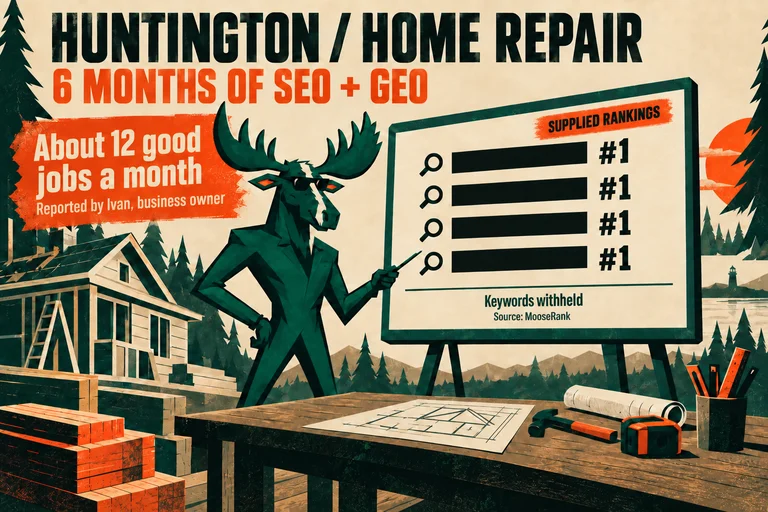
E extends MOOSE
Market evidence selects the questions. On-page work creates useful sources. Off-page authority corroborates the entity. The technical foundation protects access. Emerging Search measures whether those signals become part of AI-generated discovery.
See the complete MOOSE campaignTalk directly with the senior strategist responsible for the campaign, or use the MOOSE Score to assess the market, pages, authority, technical foundation, and Emerging Search readiness together.