
Google Search
Build clear service, county, and decision-stage pages that match how qualified local customers search and compare providers.
The complete MOOSE campaign / Local SEO services
Help the right customers find, trust, and contact your service business across Google Search and Google Maps. MooseRank connects real local demand with your Google Business Profile, website, reviews, citations, and conversion paths.


The complete local decision
Local visibility only creates value when the searcher needs the right service, sits inside the real operating territory, trusts what they find, and can take the next step.
Build clear service, county, and decision-stage pages that match how qualified local customers search and compare providers.
Align your Google Business Profile, reviews, categories, services, website, and real operating territory without pretending proximity can be engineered away.
Strengthen the consistent business facts, useful pages, reviews, and third-party corroboration that answer platforms can understand—without promising a citation.
The commercial scope
The campaign connects the profile, website, local proof, wider business footprint, and measurement around the same priority services and markets. The order changes with the evidence; the responsibilities do not.
Compare real demand, map-pack and organic competitors, commercial value, seasonality, service radius, and lead capacity before choosing where to compete.
Review eligibility, categories, services, service areas, hours, landing pages, photos, updates, duplicates, conversion details, and avoidable policy risks.
Give every valuable service and geography one intended page owner so the site covers demand without creating competing or interchangeable URLs.
Build useful local landing paths with real scope, project proof, service-area context, customer questions, and a clear next action—not town-name swaps.
Find incorrect or duplicate business information and align the name, phone, location or service area, hours, website, and priority directory records.
Create a policy-safe process for earning, responding to, learning from, and presenting genuine reviews where they help customers make a decision.
One connected journey
Find the real competitive field. Align the business everywhere it appears. Remove contradictions. Give the customer useful proof and an obvious next action.

Service-area businesses
A storefront, hybrid business, and service-area business have different profile requirements. We start with the real operating model and protect it from avoidable suspension risk.
Nassau and Suffolk contain distinct markets. Search demand, travel time, job value, seasonality, existing customers, and crew capacity determine the priority territory.
A location page earns its place through real projects, original photos, local reviews, verified service boundaries, or genuinely useful market information—not a changed place name.
See how the operating context changes across Nassau County and Suffolk County. Heating and cooling businesses can explore our HVAC SEO strategy for Long Island for seasonal demand, dispatch coverage, and service-page planning.
How the campaign moves
The sequence begins with the constraint that limits qualified visibility now. We do not hide a fixed task calendar behind the word strategy.
What you receive
A deliverable is only valuable when it changes a decision or enables the next piece of work. Each output identifies the evidence, recommendation, owner, and completion condition.
Priority services, markets, competitors, search-result patterns, constraints, and recommended page owners.
A prioritized record of profile corrections, opportunities, policy considerations, conversion improvements, and owner-supplied inputs.
A practical hierarchy showing which pages to keep, rebuild, merge, or create—and which tempting pages not to publish.
Priority inconsistencies, duplicate risks, missing corroboration, and the verified business facts every source should reinforce.
Platform priorities, request moments, response guidance, proof themes, and a sustainable process the business can actually maintain.
Ordered work across the profile, website, local pages, internal links, proof, authority, technical foundation, and conversion experience.
Search Console, profile interactions, calls, forms, landing-page performance, and lead-quality signals tied back to the campaign priorities.
Proof before promises
MooseRank separates what was observed, what can reasonably be inferred, and what the business should do next. Recommendations can include the exact search results reviewed, profile and citation inconsistencies, page ownership decisions, technical constraints, and the lead path each priority is meant to improve.
As permissioned client studies become available, they will document the baseline, work performed, timeframe, data source, outcome, and important limitations—not just a percentage without context.
See what the MOOSE Score examinesClient story / Huntington, NY
A Huntington home repair and renovation owner describes the work coming into his business after six months of SEO + GEO.
Ivan · Home repair and renovation business owner
Read Ivan’s SEO + GEO client story ↗Client-reported outcome, published with permission. Individual results vary.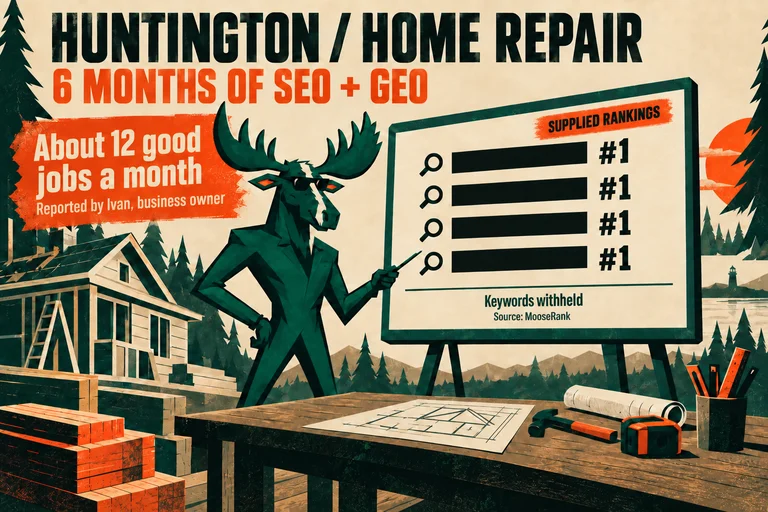
Before we work together
Transparent commercial model
MooseRank's published program normally begins with a $2,500 website and SEO foundation in month one, followed by $1,095 per month for ongoing strategy, implementation, content, local search, authority, and measurement. The approved scope depends on what the business and current site actually need.
See pricing and fitLocal SEO field guides
Use these evidence-led guides to evaluate profile decisions, website architecture, reputation, authority, Maps visibility, and geographic measurement.
Connect profile eligibility, pages, proof, authority, and measurement across a real territory.
Set coverage and address visibility correctly without treating place names as ranking radius.
Choose one accurate primary identity and only genuine supporting categories.
Audit ownership, eligibility, services, hours, links, media, reviews, and measurement.
Correct material contradictions on the third-party sources customers and platforms use.
Build a neutral, policy-safe request and response system around genuine experiences.
Give every local URL a distinct customer job and avoid doorway-page expansion.
Improve relevance and prominence, respect distance, and reject risky shortcuts.
Measure visibility from many coordinates and connect the pattern to qualified outcomes.
Straight answers
There is no universal timeline. The starting website, Google Business Profile, competition, proximity, reviews, authority, market size, implementation speed, and business history all matter. MooseRank establishes a baseline, fixes the highest-impact constraints first, and reports movement without promising a fixed ranking date.
No. Local results can change by searcher location, query, device, competition, profile eligibility, relevance, prominence, and other factors outside an agency's control. MooseRank improves the signals and experience the business can legitimately influence but does not guarantee placement.
Usually not. A separate page should resolve a distinct local decision and contain unique operational value such as projects, original photos, reviews, service boundaries, or market-specific information. When multiple place names express the same intent, one stronger county or service-area owner is often better.
Yes. The work can include eligibility and ownership review, categories, services, service areas, hours, business description, landing-page alignment, photos, updates, duplicate issues, review development, conversion details, and measurement. Some changes require verified information or direct owner approval.
A business that visits or delivers to customers and does not serve customers at its address may be eligible as a service-area business. The profile should reflect the real model, and the address should not be displayed merely to influence rankings. Eligibility and current Google guidance are reviewed before changes are recommended.
Reviews contribute to customer trust and can support local prominence, but they are only one part of the system. Recency, authenticity, owner responses, service detail, overall reputation, profile quality, proximity, website relevance, and wider authority all interact.
Local SEO adds location-sensitive search results, Google Maps, Google Business Profile, reviews, citations, service areas, and local proof to the normal work of building useful pages, technical access, internal links, authority, and conversion paths.
Yes, when the business genuinely serves both and the budget, proof, competition, and lead capacity support the scope. MooseRank usually prioritizes the strongest opportunity first and expands from demonstrated traction rather than treating both counties as interchangeable.
Measurement can connect Search Console landing-page performance, Google Business Profile interactions, tracked calls, forms, engagement, and lead-quality feedback. Rankings are useful diagnostic signals, but qualified inquiries and business outcomes determine whether the campaign is moving in the right direction.
Local is one connected system
Market selection directs the work. Pages create relevance and a destination. Authority corroborates the business. The technical foundation protects access and measurement. Emerging Search extends those signals into AI-driven discovery.
See the complete MOOSE campaignTalk directly with the senior strategist responsible for the campaign, or use the MOOSE Score to identify the strongest constraint first.