
Free field tool
Does your target town need its own page?
Compare the pages Google ranks for your service and town, check existing website coverage, and turn the evidence into a local page brief.
The short answer
Build a location page for a real location and a service-area page for a distinct market decision.
If customers can visit a legitimate staffed branch, a location page can represent it. If the business travels to customers, a service-area page can explain how it serves a market. If the content, offer, proof, and logistics do not materially change, consolidate under one stronger regional owner instead of creating another URL.
Choose the page type
Match the page to business reality.
| Page | Use when | Evidence expected |
|---|---|---|
| Location | Customers visit a real staffed branch | Address, hours, staff, photos, directions, local reviews |
| Service area | The business travels into a distinct market | Services, projects, constraints, coverage, reviews, logistics |
| Regional hub | Several places share one customer decision | Useful hierarchy, broad proof, links to justified child pages |
| No new page | Only the place name would change | Strengthen the existing owner instead |
Require information gain
Every local URL needs a customer job.
- Different demandThe market uses distinct services, terminology, or decision criteria.
- Different operationsTravel, response, licensing, property conditions, or availability changes.
- Different proofProjects, photos, customers, testimonials, or team members anchor the page.
- Different next stepThe inquiry route, office, schedule, or qualification genuinely changes.
Avoid doorway abuse
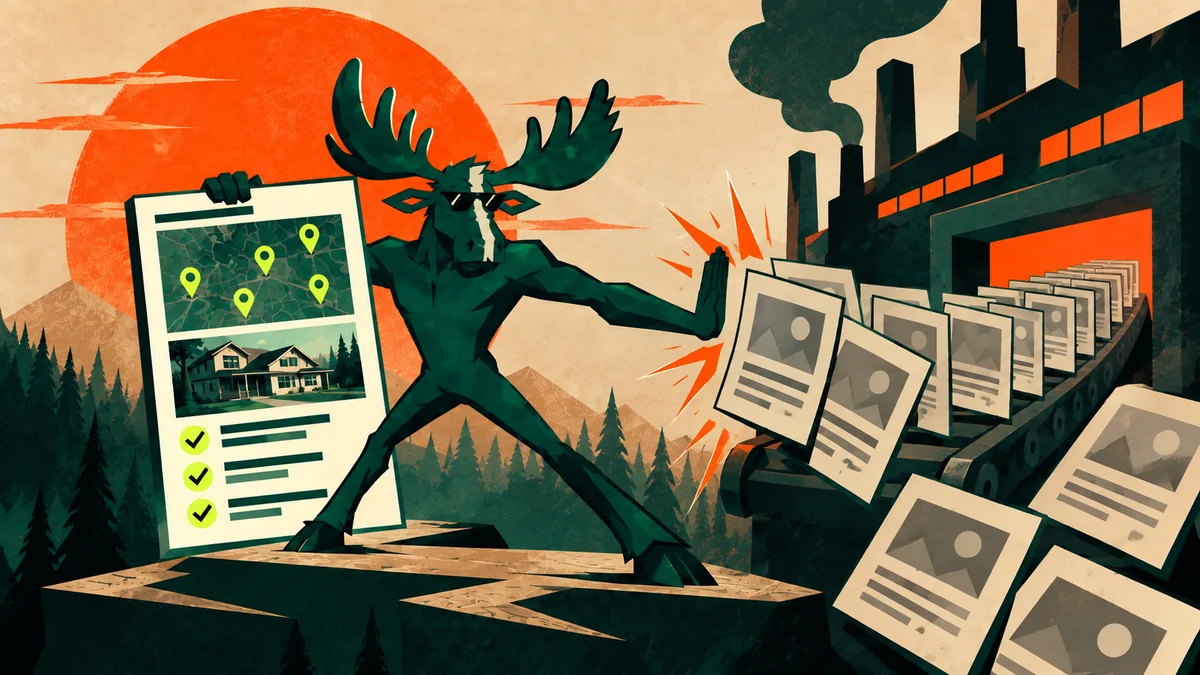
Substantially similar city pages can become a liability.
Google defines doorway abuse as pages created to rank for specific, similar queries that funnel people toward the usable part of the site. Swapping place names across dozens of otherwise identical pages creates weak information value and competing ownership.
Before expanding, map every query group to one canonical page. Review the existing Nassau County and Suffolk County owners, then decide whether a narrower market deserves its own evidence.
Consolidation
Do not delete weak pages without checking what they already carry.
Review impressions, rankings, links, conversions, internal links, and intent overlap. The correct disposition may be rebuild, merge and redirect, retain with a clearer job, canonicalize, or remove. Preserve the strongest useful material and update navigation and sitemap references.
This page-ownership work belongs inside local SEO and Google Maps optimization, not a town-page quota.
Build the local system
Turn local visibility into qualified demand.
MooseRank connects your Google Business Profile, website, reviews, citations, service territory, authority, and measurement inside one evidence-led campaign.
Straight answers
Service-Area Pages vs Location Pages: common questions
01What is the difference between a location page and a service-area page?+
A location page represents a legitimate customer-facing office or branch. A service-area page explains service delivery, proof, constraints, and customer decisions for a market where the business travels or delivers.
02Can a business build pages for every town it serves?+
It can publish useful pages where real differences and evidence justify them. Publishing many substantially similar city pages that funnel visitors to the same destination can match Google’s description of doorway abuse.
03What makes a local page genuinely unique?+
Useful distinctions can include specific services, projects, photos, reviews, staff, regulations, logistics, response expectations, property conditions, pricing factors, and links to relevant local resources.
04Should weak town pages be deleted?+
First assess rankings, links, conversions, and intent overlap. Depending on the evidence, improve, consolidate, redirect, retain, or remove them. Do not delete performing URLs without a migration plan.
Primary sources
Documentation reviewed
- Google Search Central: Spam policies and doorway abuse
- Google Business Profile Help: Manage service areas
- Google Business Profile Help: Tips to improve your local ranking
Google’s current doorway-abuse policy and service-area guidance were reviewed September 13, 2026. Page creation should follow documented customer value and canonical ownership.

About the author
The Moose
The Moose is the Founder of MooseRank and writes about SEO strategy, local search visibility, and the evidence businesses should use to make better search decisions.
Meet The Moose and the MooseRank system