
The short answer
Win the market you can actually serve.
Local SEO for a service-area business connects one legitimate business entity to the searches, map results, pages, proof, and conversion paths customers use across a real operating territory. Start with Business Profile eligibility and accurate facts. Then build relevant service and market pages, genuine reviews, consistent third-party records, local authority, and location-aware measurement.
Do not create fake offices, expose a residential address customers cannot visit, or publish interchangeable town pages. Those shortcuts introduce policy, trust, and cannibalization risks without changing the business's real proximity.
Know the operating model
Service-area and hybrid businesses need different profile settings.
A service-area business travels to or delivers to customers and does not serve them at its base. A hybrid business both receives customers at a staffed, signed location and travels or delivers. Google instructs a pure service-area business to hide its address and generally maintain one profile for the area it serves.
The first audit question is therefore not “Which cities do we want to rank in?” It is “Where does the business legally and operationally exist, where can customers interact with it, and which territory can it serve profitably?”
The five-part system
Local visibility compounds when the profile and website tell one story.
- 01
Eligibility and identity
Confirm ownership, business type, name, address handling, phone, website, hours, and verification evidence.
- 02
Relevance
Choose accurate categories and services, then give each priority service and local decision a clear canonical page.
- 03
Proof
Show completed work, original photos, real reviews, qualifications, processes, limitations, and the people accountable for the service.
- 04
Prominence
Earn relevant links, mentions, listings, associations, and community references that corroborate the business.
- 05
Measurement
Track geographic visibility, profile interactions, landing pages, calls, forms, booked work, and lead quality.
Website architecture
Build around services and decisions before multiplying locations.
A strong service page explains the work, customer problem, process, evidence, pricing factors, and next step. A local page earns a separate URL only when the market changes that decision and the business can support the difference with useful facts or proof.
Use the service-area versus location-page framework before publishing city pages. Nassau and Suffolk may justify separate commercial owners; twenty thin town pages with swapped headings may not.
Profile and reputation
Complete information helps, but trustworthy evidence closes the gap.
Google recommends accurate, complete profile information, relevant categories, current hours, photos, and review responses. The website should reinforce the same facts and provide the depth the profile cannot.
Build a neutral review request into the completed-service workflow. Correct important citations and duplicates. Promote original work to local organizations and relevant publishers. These are not isolated tricks; they make the same business easier to verify across sources.
Distance-aware measurement
Measure a market, not one browser.
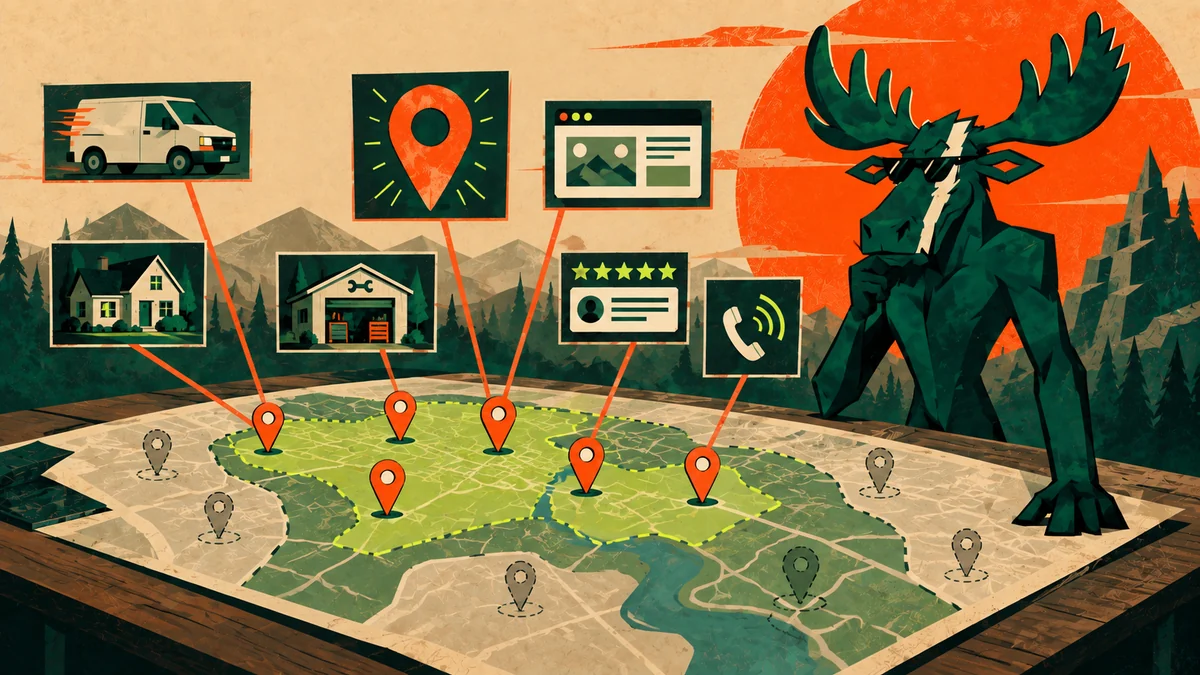
Google says local results are mainly based on relevance, distance, and prominence. A single rank check hides the distance component. A local-search geogrid repeats the same query at many coordinates so you can see where visibility is strong, weak, or changing.
Compare stable scans before and after documented work, but never treat grid color as revenue. Pair it with Business Profile searches and interactions, website conversions, call quality, booked jobs, and territory capacity.
Commercial next step
Local SEO should make the operating territory more valuable.
MooseRank's local SEO and Google Maps optimization combines the profile, website, reviews, citations, authority, market selection, and measurement inside one campaign. The goal is qualified demand—not a report full of green pins.
Build the local system
Turn local visibility into qualified demand.
MooseRank connects your Google Business Profile, website, reviews, citations, service territory, authority, and measurement inside one evidence-led campaign.
Straight answers
Local SEO for Service-Area Businesses: common questions
01What is a service-area business in Google Business Profile?+
It is a business that travels to or delivers to customers and does not serve them at its address. Google says these businesses should hide the address, define accurate service areas, and generally use one profile for the area they serve.
02Does adding more service areas improve rankings?+
Adding place names tells customers where you operate; it does not remove the role of distance. Google identifies relevance, distance, and prominence as its main local ranking considerations.
03Should a service business create a page for every town?+
Only when each page resolves a distinct local decision with useful evidence such as projects, service constraints, original photos, testimonials, or local logistics. Near-duplicate pages created mainly to capture similar queries risk becoming doorway pages.
04How should service-area businesses measure local SEO?+
Combine geogrid visibility, Business Profile searches and interactions, landing-page performance, calls, forms, booked work, lead quality, and revenue. No single metric explains the full customer journey.
Primary sources
Documentation reviewed
- Google Business Profile Help: Manage service areas
- Google Business Profile Help: Tips to improve your local ranking
- Google Business Profile Help: How Google sources business information
- Google Search Central: Spam policies and doorway abuse
Official Google documentation was reviewed September 13, 2026. Recommendations beyond published rules are presented as an evidence-led operating framework, not undisclosed ranking factors.

About the author
The Moose
The Moose is the Founder of MooseRank and writes about SEO strategy, local search visibility, and the evidence businesses should use to make better search decisions.
Meet The Moose and the MooseRank system