
The short answer
Improve relevance and prominence while measuring distance honestly.
Verify an eligible profile, keep information complete and accurate, choose the right categories, describe real services, align the linked website, earn genuine reviews, build credible local authority, and remove entity contradictions. Google identifies relevance, distance, and prominence as the main local ranking considerations; no legitimate tactic eliminates the searcher's location.
The published model
Start with what Google actually says.
| Factor | Meaning | Work you can influence |
|---|---|---|
| Relevance | How well the profile matches the search | Categories, services, accurate detail, landing-page alignment |
| Distance | How far the business is from the searcher | Truthful location and realistic territory; not fake offices |
| Prominence | How well-known the business is | Reviews, links, mentions, listings, reputation, offline stature |
Priority sequence
Fix the controllable constraints in order.
- 01
Protect eligibility
Resolve ownership, verification, duplicates, business type, address handling, and policy risks.
- 02
Clarify relevance
Choose accurate categories and services; make the linked page the strongest owner of the decision.
- 03
Improve confidence
Correct hours and contact paths; add original photos, useful detail, and genuine reviews.
- 04
Earn prominence
Build local and industry references that a customer would recognize as credible.
- 05
Measure the field
Track geographic visibility and connect it to profile interactions, leads, and revenue.
GeoGrid measurement
Use a grid because there is no single city-wide ranking.
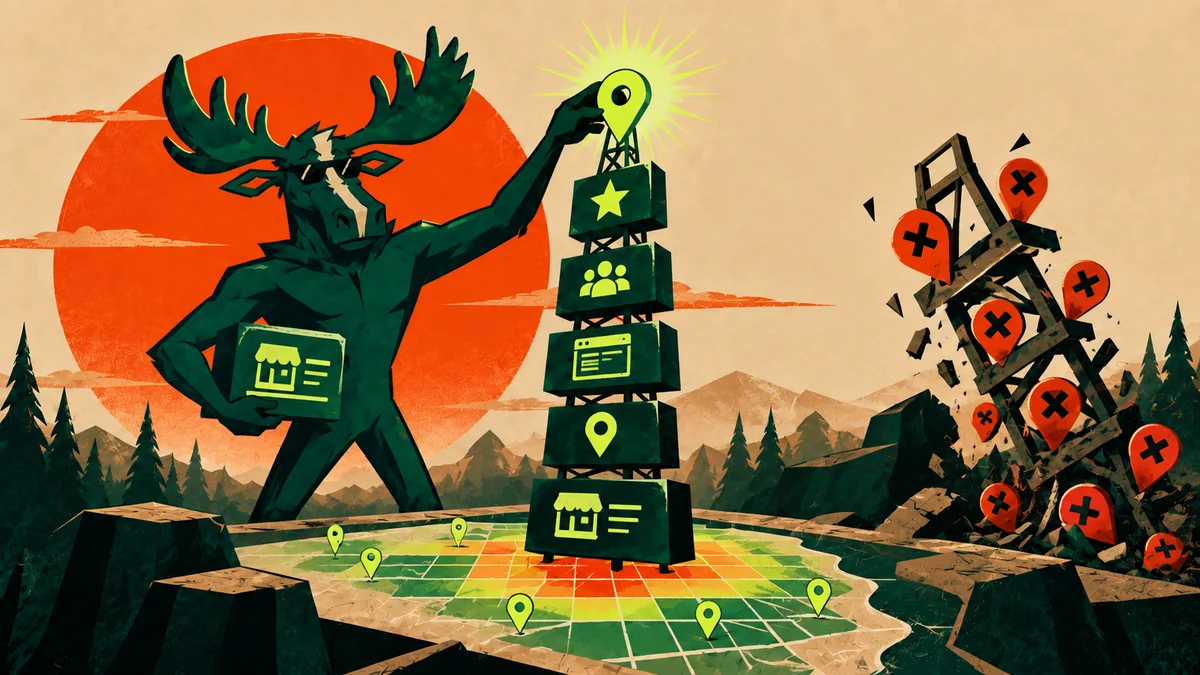
A geogrid checks the same business and keyword from multiple coordinates, then colors the positions across the market. A tool such as Local Viking can schedule and store these scans, including a mode designed to include service-area businesses.
Hold the grid center, size, point spacing, keyword, business, device or mode, and cadence consistent. Compare like with like. Use our geogrid tracking guide for the full setup and interpretation model.
Avoid shortcuts
Do not trade temporary visibility for entity or policy risk.
- No keyword-stuffed business namesUse the real-world name consistently.
- No fake or virtual officesA pin is not a location customers can use.
- No review incentives or gatingAsk for genuine feedback neutrally.
- No duplicate town pagesRequire distinct decisions and local proof.
- No ranking guaranteesDistance, competition, systems, and search context remain outside agency control.
Commercial outcome
Maps visibility should end in a qualified customer action.
Measure calls, website visits, forms, booked work, lead quality, service fit, and revenue alongside rankings. MooseRank's Google Maps optimization connects every profile action to the wider website and business system.
Build the local system
Turn local visibility into qualified demand.
MooseRank connects your Google Business Profile, website, reviews, citations, service territory, authority, and measurement inside one evidence-led campaign.
Straight answers
How to Rank Higher on Google Maps: common questions
01Can I pay Google for a better Maps ranking?+
No. Google states there is no way to request or pay for a better organic local ranking. Advertising is a separate placement and does not buy organic position.
02What are Google’s main local ranking factors?+
Google publicly describes local results as mainly based on relevance, distance, and prominence. The exact systems and weighting are not fully disclosed.
03What is a local-search geogrid?+
A geogrid checks the same business and keyword from multiple coordinates across an area, displaying how visibility changes by searcher location. It is more informative than one rank checked from one device or ZIP code.
04Does Local Viking improve rankings?+
Local Viking is a tracking and management tool, not a ranking switch. Its GeoGrid can help observe local visibility patterns and compare scans over time; the underlying business and campaign work creates the change being measured.
Primary sources
Documentation reviewed
- Google Business Profile Help: Tips to improve your local ranking
- Google Business Profile Help: Manage your business category
- Google Business Profile Help: Tips to get more reviews
- Local Viking: GeoGrid visibility tracking
Google’s local-ranking guidance and Local Viking’s product documentation were reviewed September 13, 2026. MooseRank has no stated affiliate relationship with Local Viking; it is included as an illustrative geogrid tool.

About the author
The Moose
The Moose is the Founder of MooseRank and writes about SEO strategy, local search visibility, and the evidence businesses should use to make better search decisions.
Meet The Moose and the MooseRank system