
The short answer
A good backlink is a credible recommendation with a useful destination.
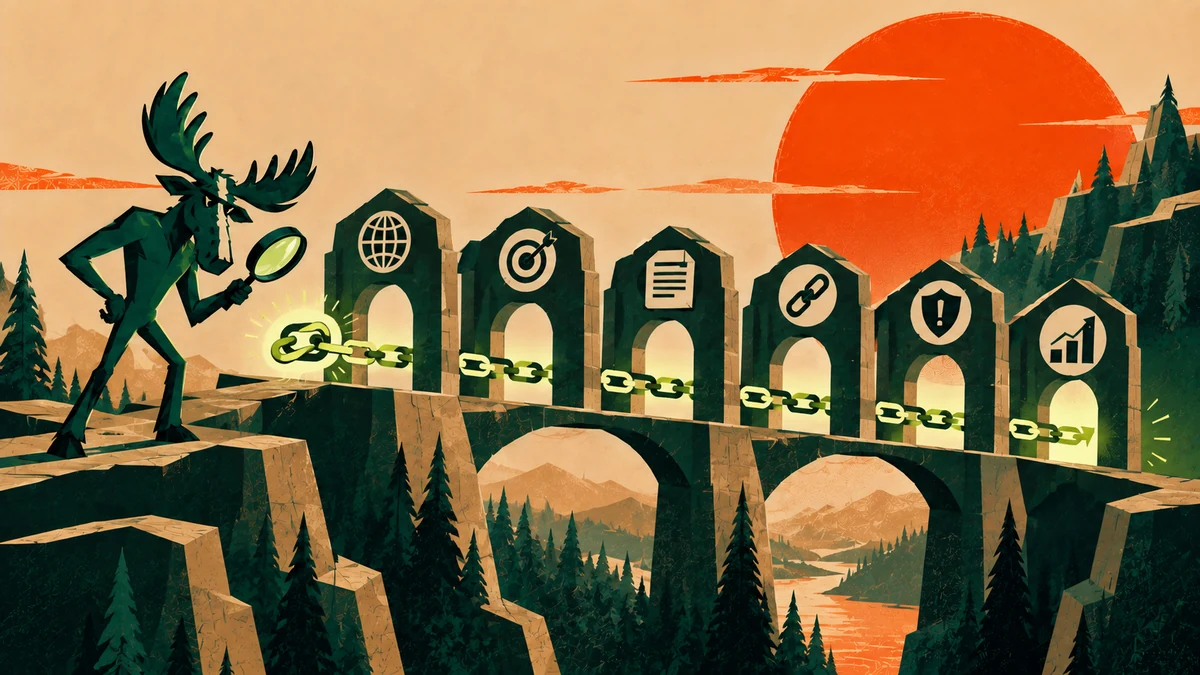
Evaluate a link in this order: source relevance, reason to cite, surrounding context, destination fit, editorial standards, and manipulation risk. Tool scores can help you investigate; they cannot decide for you.
Six observable checks
Replace “high authority” with questions you can answer.
Stop conditions
A polished sales page can still sell a bad link.
- Hundreds of unrelated categories, cities, or outbound posts published to a quota.
- A guaranteed followed link with required keyword-rich anchor text.
- No visible audience or editorial purpose beyond selling placements.
- A destination chosen for ranking manipulation rather than reader usefulness.
- Private-network language, recycled content, false authors, or undisclosed sponsorship.
One weak signal is a reason to investigate. A pattern of them is a reason to walk away.
After the mention
Verify that the opportunity became durable evidence.
Record the live URL, source owner, publication date, destination, anchor context, relationship, and disclosure. Then watch for qualified referral visits, discovery, additional citations, assisted conversions, and whether the page stays maintained. The best opportunities often create a relationship or reference that matters beyond the first link.
A backlink report counts what exists. An authority review explains why it deserves to exist.
From opportunity to authority
Authority work should leave behind evidence—not just a link count.
MooseRank's off-page SEO and authority building work evaluates the source, the reason for the mention, its context, the destination, the risk, and the business outcome as one system.
As a SEO services company on Long Island, MooseRank connects earned authority to the service and market pages customers actually need.
Build authority worth verifying
Pursue the sources that make the business easier to trust.
Bring the market, priority pages, current mentions, and competitor set. MooseRank will separate useful opportunities from noise and build a defensible campaign.
Straight answers
Common questions
01What makes a backlink high quality?+
A high-quality backlink comes from a relevant, credible source that has a genuine editorial or business reason to reference a useful destination in meaningful context. No single third-party metric proves quality.
02Is domain authority a Google ranking metric?+
No. Domain Authority and similar scores are third-party estimates, not Google metrics. They can help with initial research but should not replace page-level relevance, editorial standards, context, traffic quality, and risk review.
03Is a nofollow link useless?+
No. A qualified link can still send relevant visitors, create discovery, support brand corroboration, and lead to other coverage. Google also treats rel attributes as information about the link relationship.
04Should I buy backlinks?+
Paying for links intended to manipulate rankings can violate Google spam policies. Advertising and sponsorships should be transparent and appropriately qualified; they should not be disguised as independent editorial endorsements.
05How many backlinks do I need?+
There is no universal number. The useful question is whether priority pages have enough relevant, credible corroboration to compete in their actual market. Quality, fit, diversity, and page destination matter more than a quota.
Primary sources
Documentation reviewed
- Google Search Essentials: link spam policies
- Google Search Central: qualifying outbound links
- Google Search Central: link best practices
Research note: official documentation was reviewed September 22, 2026. MooseRank's frameworks are practical decision aids, not Google scoring systems or ranking guarantees.

About the author
The Moose
The Moose is the Founder of MooseRank and writes about SEO strategy, AI search visibility, and the evidence businesses should use to make better search decisions.
Meet The Moose and the MooseRank system