
The short answer
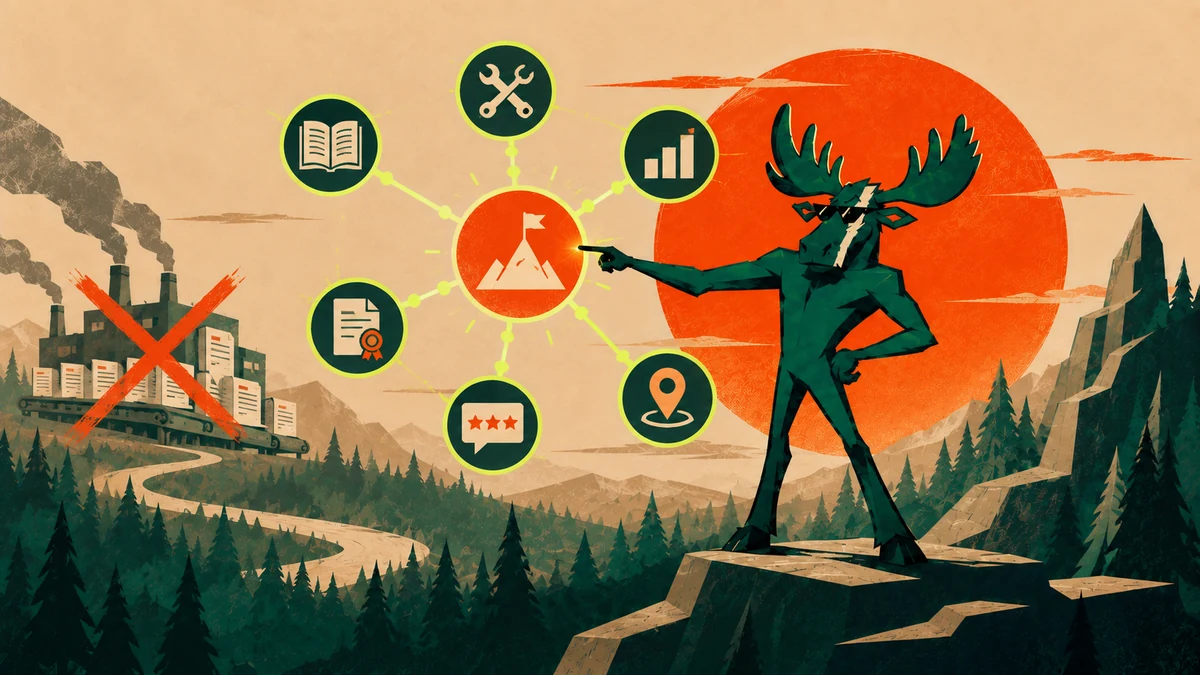
Map the complete decision around one commercial owner.
Choose the service or pillar that deserves ownership. Add only the questions, comparisons, tools, proof, local evidence, and adjacent decisions that have a distinct customer job. Link them so people and crawlers can understand the relationship.
Choose the center
The hub is an owner—not merely the longest article.
A service page can own hiring intent while a pillar owns a broad educational system. Decide which customer action sits at the center, what the page must prove, and how support will help someone move toward or through that decision. Avoid creating an informational pillar that competes with the commercial service owner.
Map five support layers
Useful topical coverage does more than define terms.
Understand
Definitions, causes, methods, and constraints that help a customer frame the problem.
Compare
Options, alternatives, costs, tradeoffs, and selection criteria.
Verify
Case evidence, process, credentials, examples, and claims the customer needs to trust.
Use
Checklists, calculators, planners, templates, and diagnostics that create original utility.
Act
Service, location, contact, booking, and next-step pages that complete the commercial path.
Design the relationships
Every supporting page should know what it supports.
- Link to the commercial or pillar owner inside relevant explanatory copy.
- Use anchors that describe the destination rather than repeating an exact phrase mechanically.
- Cross-link only closely related support where the reader has a real next question.
- Expose priority guides from the owner page through a useful resource library.
- Remove or consolidate support that duplicates another page's job.
Measure the system
Judge the cluster by coverage and movement—not page count.
Track whether the owner gains relevant impressions, clicks, internal-link support, qualified actions, and coverage across the intended query families. Review which supporting assets assist discovery and conversion, which earn independent references, and which never develop a distinct role.
Topical authority is the result of becoming genuinely useful and well corroborated across a subject—not the act of filling every keyword cell.
Connect strategy to execution
A priority is only useful when the campaign can act on it.
MooseRank's connected SEO campaign turns market evidence into page owners, sequenced work, and measurable commercial outcomes.
As a SEO services company on Long Island, MooseRank keeps research tied to the services, markets, and customer decisions the business actually wants to win.
Choose the next move
Turn the opportunity set into an accountable plan.
Bring the services, markets, current pages, and search evidence. MooseRank will identify what to build, improve, consolidate, support, or defer.
Straight answers
Common questions
01What is a topical authority content map?+
It is a plan connecting a priority subject and commercial owner to the distinct questions, comparisons, proof, tools, and related decisions customers need, along with their internal-link relationships.
02Does more content create topical authority?+
Not by itself. Useful coverage requires distinct purpose, credible evidence, clear ownership, maintenance, and relationships among pages. Thin or repetitive publishing can create noise and overlap.
03What should be at the center of a topic cluster?+
Use the page that owns the primary customer decision—often a service page or a comprehensive pillar. Supporting assets should help people reach, understand, trust, or act on that owner.
04How many supporting articles does a silo need?+
There is no fixed number. Build the minimum set needed to cover meaningful decisions and evidence gaps, then expand when real search and customer data reveals another useful job.
05How should topic-cluster pages link together?+
Supporting pages should link contextually to the owner and to closely related guides when that helps the reader continue. The owner should expose the most important supporting resources without creating a repetitive link block everywhere.
Primary sources
Documentation reviewed
- Google: creating helpful, reliable, people-first content
- Google: link best practices
- Google Search Essentials
Research note: documentation was reviewed September 22, 2026. MooseRank's planning models are practical applications of observable search evidence—not Google ranking-factor labels, fixed formulas, or guarantees.

About the author
The Moose
The Moose is the Founder of MooseRank and writes about SEO strategy, AI search visibility, and the evidence businesses should use to make better search decisions.
Meet The Moose and the MooseRank system