
The short answer
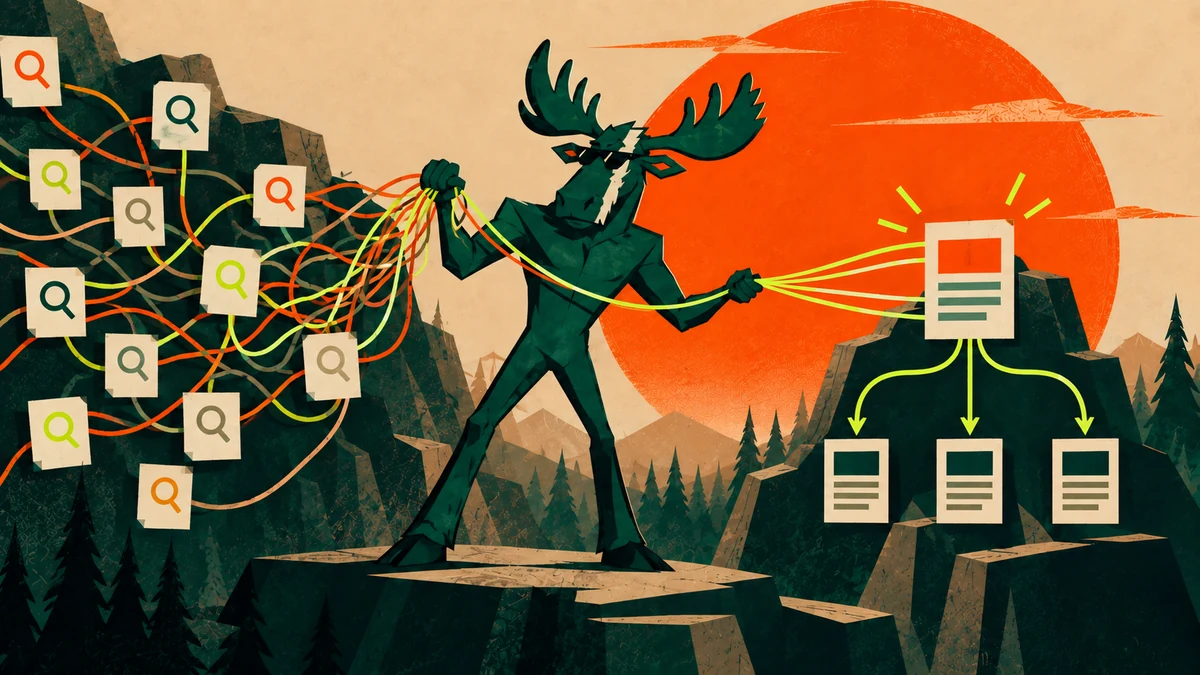
Map a decision to an owner—not a keyword to an empty URL.
Group phrases with the same intent and page expectation. Audit the current site for the strongest candidate. Then choose one action: keep, improve, consolidate, reposition, build, or defer.
The ownership rule
One owner can serve many variations when the job stays the same.
Keep a family together when the searcher wants the same outcome, the SERP rewards the same page type, the same evidence answers the need, and the same conversion action follows. Split it when service scope, geography, audience, problem, or buying stage changes the page's required job.
Six mapping steps
Audit before you add.
- Group queries by shared intent and expected page type.
- Define the customer decision and the appropriate next action.
- Inventory every existing URL that might plausibly own the family.
- Choose the strongest owner using relevance, proof, performance, links, and maintainability.
- Decide whether to keep, improve, consolidate, reposition, build, or defer.
- Map supporting pages and descriptive internal links into the owner.
Resolve conflicts
Two pages can coexist only when each has a distinct useful job.
| Situation | Decision |
|---|---|
| Same intent, same offer, same proof | Consolidate into the stronger owner |
| Same topic, different buying stage | Keep separate and link guide to service |
| Same service, genuinely distinct market evidence | Keep separate local owner where justified |
| Thin old page with useful links | Redirect to the closest complete owner |
| Query family lacks value or evidence | Defer instead of publishing filler |
The living map
Record what future editors need to know.
For every family, store the primary decision, related language, intent, SERP pattern, owner URL, status, evidence required, supporting URLs, internal-link anchors, priority, and last review date. The map should guide briefs, navigation, redirects, measurement, and future consolidation.
A page map is successful when the team can explain why every important URL exists and which demand it owns.
Connect strategy to execution
A priority is only useful when the campaign can act on it.
MooseRank's connected SEO campaign turns market evidence into page owners, sequenced work, and measurable commercial outcomes.
As a SEO agency on Long Island, MooseRank keeps research tied to the services, markets, and customer decisions the business actually wants to win.
Choose the next move
Turn the opportunity set into an accountable plan.
Bring the services, markets, current pages, and search evidence. MooseRank will identify what to build, improve, consolidate, support, or defer.
Straight answers
Common questions
01What is keyword-to-page mapping?+
It is the process of assigning each coherent keyword family and customer decision to the existing or planned page best suited to own it.
02Should one keyword map to one page?+
Not usually. Closely related phrases can map to one page when they share intent, page type, core answer, evidence, and conversion action.
03Can one page target multiple services?+
Only when customers and search results treat them as one decision. Distinct services with different proof, questions, or buying actions usually deserve distinct owners.
04How does keyword mapping prevent cannibalization?+
It makes ownership explicit before publishing, exposes multiple pages competing for the same job, and documents whether to merge, reposition, redirect, or keep them separate.
05What should a keyword map include?+
Include the query family, intent, page type, current URL, proposed owner, action, supporting pages, internal links, evidence requirements, priority, and measurement plan.
Primary sources
Documentation reviewed
Research note: documentation was reviewed September 22, 2026. MooseRank's planning models are practical applications of observable search evidence—not Google ranking-factor labels, fixed formulas, or guarantees.

About the author
The Moose
The Moose is the Founder of MooseRank and writes about SEO strategy, AI search visibility, and the evidence businesses should use to make better search decisions.
Meet The Moose and the MooseRank system