
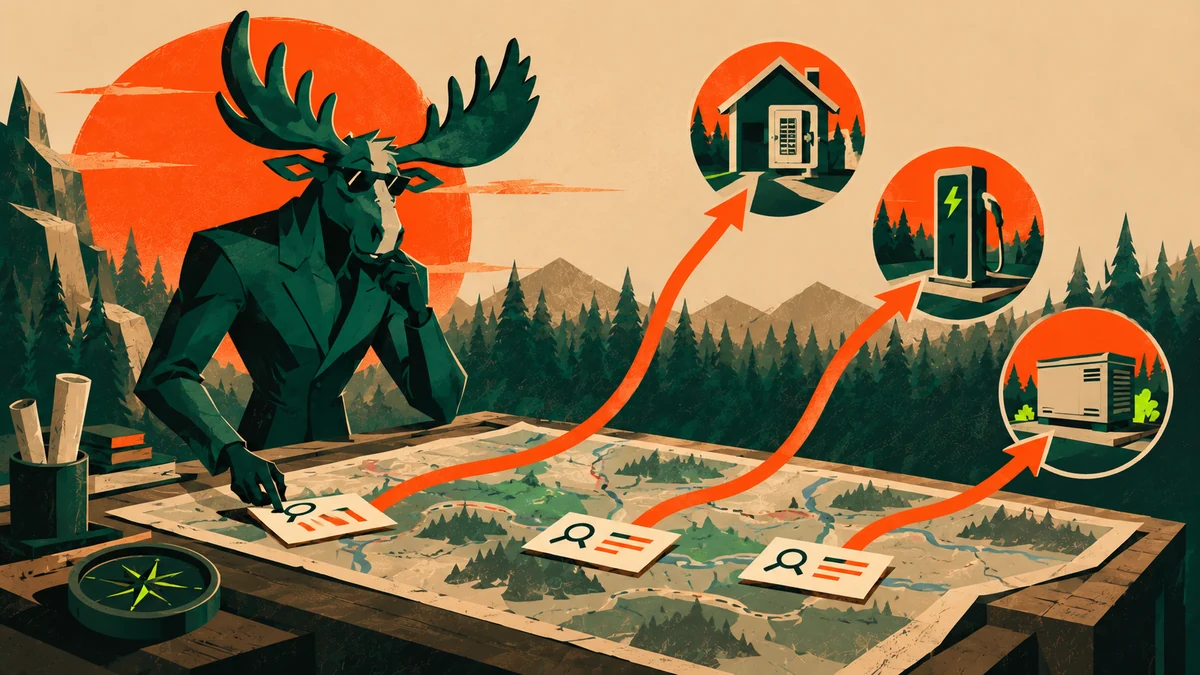
The short answer
Research the job and the customer. Assign one useful page before adding another.
Build electrician keyword families from real services, customer type, urgency, and territory. Inspect current local results, match each family to an existing page, and improve that owner before proposing a new one. Separate different buying decisions; group wording variations that need the same answer.
This is MooseRank's planning framework. The original Long Island observations below inform questions to investigate. The worked page map is illustrative and needs validation against your business and market.
01 / Start with the operating picture
Which calls should the office accept?
Before opening a keyword tool, ask the owner or dispatcher what the team can book. A useful keyword map begins with service capability and capacity. Search demand for generators or commercial maintenance is not a reason to advertise work the business does not perform.
- Job: repairs, panel/service upgrades, lighting, EV charging, generators, or another verified specialty.
- Customer: homeowners, landlords, property managers, commercial facilities, or procurement teams where actually served.
- Timing: scheduled estimates, routine service, and genuinely staffed emergency work.
- Territory: operating bases, travel limits, minimum job requirements, and where each crew can deliver.
- Evidence: relevant completed projects, customer permission, verifiable credentials, and accurate service terms.
- Capacity: estimate slots, equipment constraints, current priorities, and the work the business wants more of.
Record recurring customer language from anonymized inquiries and job records. Avoid publishing private customer details. The map should explain how a request reaches the right person, not simply how a phrase reaches a URL.
02 / Original Long Island observations
One broad phrase can surface different kinds of business.
Our October 29, 2026 study selected the first three qualifying provider websites for “electrician Long Island” from a Huntington-origin desktop snapshot. They appeared at organic positions 1, 3, and 6. All three named Nassau County and linked to multiple service destinations. Two linked directly to both panel and generator service pages; the third emphasized commercial, industrial, and transportation work.
That third business is Welsbach, an EMCOR-owned contractor. Its presence is a reason to inspect customer fit before copying a competitor's structure. A facilities buyer and a homeowner may use related contractor language while needing different evidence.
Read the original comparison and methodology for the businesses, complete primary selection record, settings, and feature definitions. Three broad-query searches returned 26 organic rows in total. This is not a measured demand study for the specific job keywords below, and shared features do not establish ranking causes.
03 / Build and test the families
Use evidence from the right market.
- Inspect your existing entrances. Use Search Console to compare queries with their landing pages. Look for a relevant job reaching an incomplete or unsuitable page. These rows describe your site's visibility, not every search in the market.
- Collect candidate language. Combine the job with customer, urgency, and real geography. Keyword Planner can provide ideas and estimated demand; its advertising competition is not organic ranking difficulty.
- Check current local results. Record origin, date, language, device, and the page types shown. Keep Maps and organic website positions separate.
- Compare close variants. Do the same destinations answer them? Inspect what those pages actually offer before deciding to combine or split a family.
- Choose the business priority. Weigh fit, qualified inquiries, capacity, available proof, existing visibility, and implementation effort. A volume estimate is one input.
Write down unknowns. If a keyword has not been measured, call it a candidate. If a destination is inaccessible, do not score its features as absent. That makes later decisions easier to audit.
04 / Worked example
An electrician page map organized by the decision.
These are hypothetical paths on an electrical contractor's website. They are not live MooseRank service URLs or a requirement to publish seven pages. Remove unsupported work and inspect existing owners first.
01 Electrical repair & fault diagnosis
- Candidate searches
- electrical repair; electrician for fault diagnosis; electrical troubleshooting
- Example page owner
/services/electrical-repair- Customer decision
- Can the company assess this type of problem in my area?
- What the page needs
- Actual diagnostic scope, territory, current staffed hours, and a direct service-request path.
02 Emergency electrical service
- Candidate searches
- emergency electrician; after-hours electrician
- Example page owner
/services/emergency-electrician — only if offered- Customer decision
- Is an appropriate service route available now?
- What the page needs
- Accurate availability and service limits. Distinguish call answering, scheduling, dispatch, and an arrival commitment.
03 Panel & electrical service upgrades
- Candidate searches
- electrical panel upgrade; breaker panel replacement; 200 amp service upgrade
- Example page owner
/services/panel-service-upgrades- Customer decision
- What does an assessment and estimate involve?
- What the page needs
- Supported work, site-assessment requirements, approved project examples, and the estimate process. Validate subgroup differences before splitting.
04 EV charger installation
- Candidate searches
- home EV charger installation; EV charging electrician
- Example page owner
/services/ev-charger-installation- Customer decision
- Can the contractor assess and deliver my charging project?
- What the page needs
- Residential or commercial fit, supported scope, equipment claims that can be verified, project examples, and estimate inputs.
05 Standby generator installation
- Candidate searches
- standby generator installation; whole house generator electrician
- Example page owner
/services/generator-installation- Customer decision
- Does this company handle the installation I need?
- What the page needs
- Actual installation responsibilities, project coordination, supported equipment, and a clear distinction from repair, portable products, or rental.
06 Lighting installation
- Candidate searches
- recessed lighting installation; interior lighting electrician; outdoor lighting installation
- Example page owner
/services/lighting-installation- Customer decision
- What kind of lighting project can I request?
- What the page needs
- Project types, interior/exterior scope, approved images, and estimate process. Split only where scope and customer needs justify it.
07 Commercial electrical work
- Candidate searches
- commercial electrician; electrical maintenance contractor
- Example page owner
/commercial-electrical-services- Customer decision
- Can the contractor meet this property or procurement requirement?
- What the page needs
- Actual facility types, maintenance or project scope, coordination, documented qualifications, and the commercial inquiry route.
05 / Avoid unnecessary pages
A different phrase is not always a different job.
Start panel upgrade, breaker-panel replacement, and 200-amp service upgrade in one candidate family. Investigate whether their scope and results need separate answers. Do not publish overlapping pages just because the wording changes. Conversely, installation and repair can need distinct owners when the work, estimate, proof, and customer questions differ.
Keep together
The same service, customer decision, evidence, and next action. Use natural variations within one useful owner.
Consider a split
Different project scope, customer type, service terms, or consistently distinct results—and enough actual business evidence to support both pages.
Defer
Unverified services, unsupported certifications, unavailable capacity, or another page that would repeat the existing answer.
Symptom searches can mix service and troubleshooting intent. An electrician's page can explain the booking process and supported diagnostic work without publishing hazardous DIY instructions or claiming to diagnose a condition remotely. This guide is about marketing architecture, not performing electrical work.
06 / Add geography with substance
Coverage does not require every service × town combination.
A Nassau-based contractor may serve several towns from one operating base. A service page can explain those areas without a separate URL for each. Add a local page when genuine coverage, useful project evidence, logistics, or customer questions give it a distinct purpose.
Keep Business Profile service areas aligned with actual operations. Do not invent offices, stuff place names into the business name, or interpret extra service-area entries as a guaranteed ranking radius. Google's doorway policy is another reason to avoid interchangeable town pages that all funnel to the same answer.
For a completed project, record approved scope, work performed, location at an appropriate level of detail, and relevant media. Link that evidence to the service it supports. It should help a customer understand capability, not merely repeat a town keyword.
07 / Download the planning worksheet
Keep the reason beside the keyword.
The CSV contains the seven illustrative families plus fields for your current URL, real service fit, evidence, search settings, decision, and measurement. Example paths are suggestions; leave them unchanged only when your own review supports them.
Download the electrician page-map worksheet ↓- Mark whether the service and customer type are genuinely supported.
- Enter the current best page before proposing a new one.
- Record the query, origin, device, date, and observed page types.
- Choose improve, group, split, consolidate, or defer, with a reason.
- Assign the proof, implementation owner, next action, and outcome record.
08 / Judge the result
Track suitable inquiries, then estimates and jobs.
Review impressions and entrances by relevant query family and page. Define calls and forms consistently, then record the requested service, territory, qualification, and outcome where the business can provide those records. A panel estimate and an unsupported after-hours call should not be treated as equal business outcomes.
Compare consistent periods and settings, note other site or campaign changes, and allow for normal variation. Keyword research creates a testable plan; it does not guarantee a timetable, a position, or a particular number of jobs.
Connect strategy to execution
A priority is only useful when the campaign can act on it.
MooseRank's SEO for electricians connects AI niche research and human judgment with service pages, local visibility, contact paths, and monthly conversion reporting.
As a Long Island SEO company, MooseRank keeps research tied to the services, markets, and customer decisions the business actually wants to win.
Choose the next move
Turn the opportunity set into an accountable plan.
Bring the services, markets, current pages, and search evidence. MooseRank will identify what to build, improve, consolidate, support, or defer.
Straight answers
Common questions
01Should an electrician’s homepage target every electrical service?+
Use the homepage to explain the company, customer fit, core territory, and main service paths. Give distinct service decisions useful destinations when the company can support them. Listing every phrase on the homepage does not replace clear service scope or relevant project evidence.
02Should panel upgrades and 200-amp service upgrades have separate pages?+
Start by evaluating them as one related family. Separate them only when the work, customer questions, evidence, and local search results support different answers. A number or wording variation alone is not a reason for another URL. An existing page can explain supported upgrade options without creating overlapping pages.
03Can an electrician target emergency searches without overnight dispatch?+
Do not imply round-the-clock availability when the business cannot provide it. Describe the current staffed hours, response process, and service limits accurately. Scheduling access, an answering service, and a guaranteed arrival time are different things.
04Should EV charger installation keywords be split by vehicle brand?+
Only when the company genuinely supports that equipment and a separate page provides distinct information customers need. Verify any installer, partner, or certification claim. Otherwise, explain supported charger and project scope within the main EV charging service page.
05Are electrical cost queries service pages or blog posts?+
Inspect the query and local results. A service page can explain the estimate process and the variables that affect scope. A broader comparison guide may help a separate research decision. Publish prices only when the business can substantiate their scope and terms; do not invent averages to fill a keyword list.
Primary sources
Documentation reviewed
- Google Ads: use Keyword Planner
- Search Console: Search results performance report
- Google Business Profile: manage service areas
- Google Search: doorway and scaled-content abuse policies
- Google Search: LocalBusiness structured data
Research note: reviewed October 29, 2026. The linked MooseRank study contains three paid Google organic searches from a Huntington, New York desktop origin, returning 26 organic rows at a total API cost of $0.006. Its three-homepage comparison is an exploratory snapshot, not a ranking-causation study. The service keyword families, example URLs, and worksheet in this guide are illustrative planning suggestions; they are not measured search volumes, difficulty scores, or verified service-specific SERP clusters. This article addresses website planning, not electrical diagnosis or installation.

About the author
The Moose
The Moose is the Founder of MooseRank and writes about SEO strategy, AI search visibility, and the evidence businesses should use to make better search decisions.
Meet The Moose and the MooseRank system