
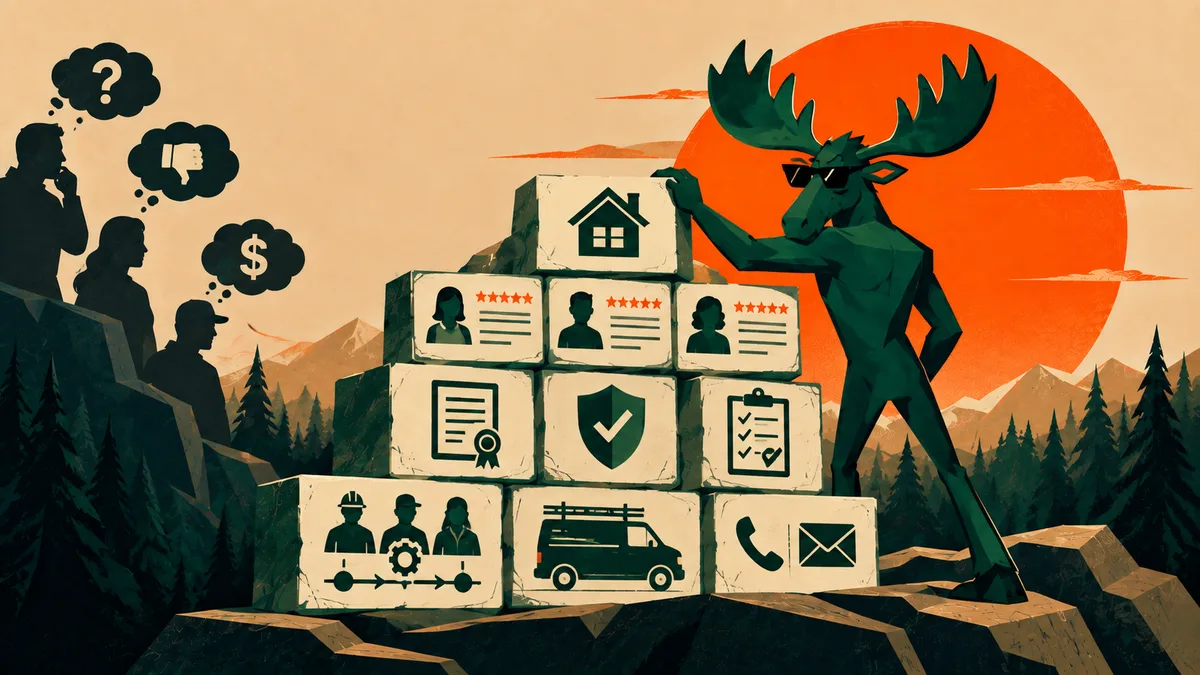
The short answer
Trust grows when the claim and the evidence touch.
Name the business clearly, show relevant work and attributable customer evidence, explain qualifications accurately, set expectations, and provide contact details customers can verify. Place each proof element beside the uncertainty it resolves.
Establish identity
Make the business easy to recognize and verify.
Use a consistent name, genuine contact details, service territory, real team or ownership context, and applicable licensing or insurance information. Explain business-model details that affect the customer instead of hiding them behind stock language.
Match proof to claim
Use evidence that is specific enough to be useful.
A service claim is strengthened by relevant projects, process evidence, customer context, and honest limitations. Reviews and endorsements should reflect genuine experiences and disclose material relationships where required.
Resolve uncertainty in place
Do not exile every trust signal to one page.
Put service-specific evidence near the service claim, location evidence near geographic claims, and privacy or response expectations near the form. Link to deeper case studies when a short proof block cannot carry the necessary context.
Keep it true
Expired proof becomes a credibility liability.
Record the source, consent, applicable dates, and owner for each credential, testimonial, statistic, and guarantee. Recheck them routinely and remove anything that can no longer be substantiated.
Connect demand to action
Conversion work should protect qualified demand—not chase button clicks.
MooseRank's connected SEO campaign aligns search intent, page ownership, proof, mobile usability, contact paths, and lead-quality measurement.
As a Long Island SEO services company, MooseRank focuses the website on the Long Island customers, services, and next steps the business actually wants.
Turn interest into qualified action
Find the friction between the search and the booked job.
Bring the priority pages, current lead routes, qualification rules, and sales feedback. MooseRank will identify the clearest conversion constraints and the evidence needed to fix them.
Straight answers
Common questions
01What are the strongest trust signals for a service business?+
Verifiable business identity, relevant project evidence, genuine customer feedback, applicable credentials, clear service territory, transparent expectations, and reliable contact details are usually stronger than generic claims.
02Where should testimonials appear?+
Place a relevant testimonial near the service, concern, or decision it supports, then provide fuller proof elsewhere. Do not repeat the same quote everywhere merely to fill space.
03Can a business use trust badges?+
Only when the badge represents a real, current relationship or qualification and customers can understand what it means. Fabricated, expired, or vague badges can undermine credibility.
04Should reviews include full customer names?+
Use only information the customer has permitted you to publish. The appropriate identity detail depends on consent, privacy, the platform source, and the evidence needed to make the testimonial attributable.
05How often should website proof be updated?+
Review it on a schedule and whenever services, credentials, policies, staff, coverage, or claims change. Remove expired or unverifiable elements promptly.
Primary sources
Documentation reviewed
Research note: documentation was reviewed September 23, 2026. Conversion recommendations require testing against the business's real traffic, lead quality, capacity, privacy obligations, and sales process; no layout or tactic guarantees leads.

About the author
The Moose
The Moose is the Founder of MooseRank and writes about SEO strategy, AI search visibility, and the evidence businesses should use to make better search decisions.
Meet The Moose and the MooseRank system