
The short answer
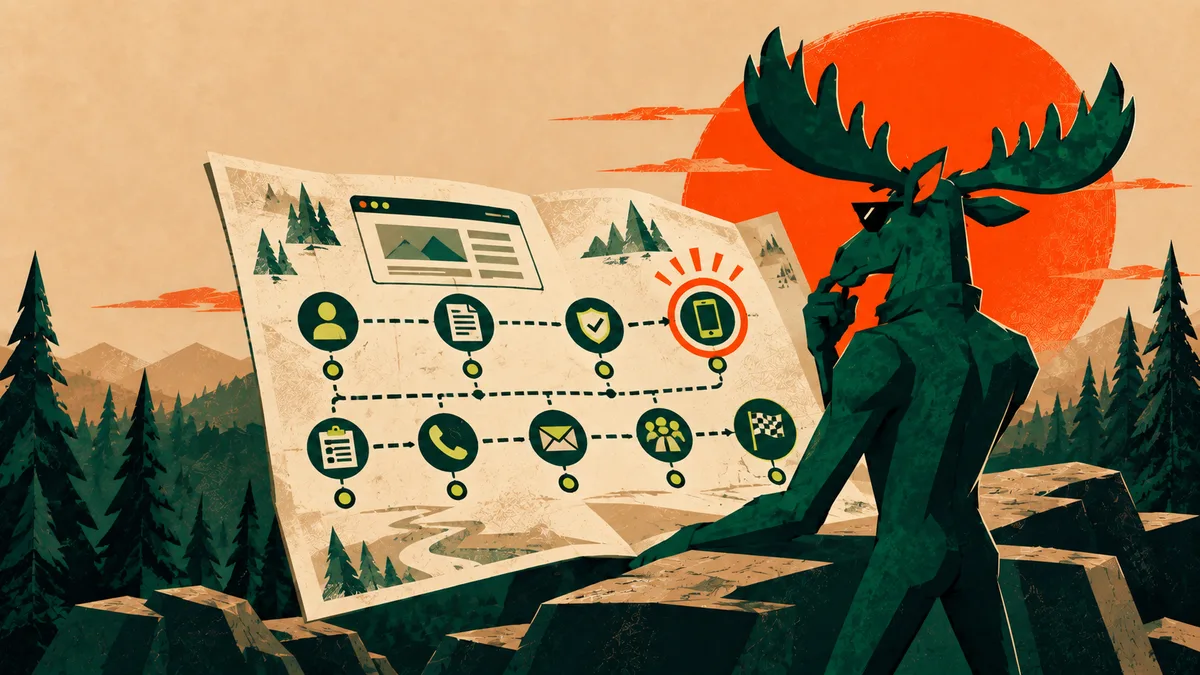
Trace one qualified journey from query to customer record.
Define the desired lead, select priority pages and contact paths, validate analytics, perform the task on real devices, inspect response and qualification, and rank verified constraints by consequence. Start with the pillar’s interactive conversion scorecard.
Define success first
Name the service, market, lead, and closed outcome.
Choose a bounded journey rather than auditing “conversion” in the abstract. Record the intended customer, page owner, primary and alternate actions, territory, qualification rules, response expectations, and commercial result.
Follow the evidence
Audit eight connected stages.
- Search intent and landing-page ownership.
- Offer clarity and expectation setting.
- Relevant proof and risk reduction.
- Mobile interaction, accessibility, and performance.
- Calls, forms, scheduling, and confirmation.
- Spam control and genuine-lead classification.
- Response time, routing, and qualification.
- Sales status, closed work, value, and feedback.
Rank constraints
Use consequence, frequency, confidence, and effort.
A broken submit action on the primary service route outranks a speculative headline test. Record the evidence, affected journey, expected mechanism, risk, owner, measurement, and rollback before changing the page.
Close the loop
Verify the repair and watch the downstream outcome.
Repeat the original task, confirm event integrity, monitor genuine and qualified leads, and collect sales feedback. Keep a change log so seasonality, media, staffing, or offer changes are not mistaken for the effect of one website adjustment.
Connect demand to action
Conversion work should protect qualified demand—not chase button clicks.
MooseRank's connected SEO campaign aligns search intent, page ownership, proof, mobile usability, contact paths, and lead-quality measurement.
As a Long Island SEO company connecting traffic to leads, MooseRank focuses the website on the Long Island customers, services, and next steps the business actually wants.
Turn interest into qualified action
Find the friction between the search and the booked job.
Bring the priority pages, current lead routes, qualification rules, and sales feedback. MooseRank will identify the clearest conversion constraints and the evidence needed to fix them.
Straight answers
Common questions
01What should a website conversion audit include?+
It should cover intent and page ownership, message clarity, proof, mobile usability, calls and forms, accessibility, measurement, qualification, response handling, sales outcomes, and technical failure states.
02Should a conversion audit start with analytics?+
Start by defining the desired customer and outcome, then validate the measurement before interpreting it. Analytics can identify patterns, but observation, testing, sales evidence, and technical checks explain them.
03How long does a conversion audit take?+
It depends on traffic, page types, lead routes, integrations, and access to sales data. A focused priority-path audit can be faster than a complete site and operations review.
04What should be fixed first?+
Prioritize verified failures that affect valuable journeys, occur often, can be changed safely, and have measurable downstream consequences. Accessibility or complete contact failures may outrank cosmetic tests.
05How do you know whether the audit worked?+
Retest the task, confirm measurement, monitor successful and qualified contacts, and compare downstream outcomes over an appropriate period. Document external factors and avoid claiming causation from a simple before-and-after change.
Primary sources
Documentation reviewed
- W3C WAI: labeling form controls
- W3C WAI: form notifications
- Google Search Central: Core Web Vitals
- Google Analytics: recommended lead events
Research note: documentation was reviewed September 23, 2026. Conversion recommendations require testing against the business's real traffic, lead quality, capacity, privacy obligations, and sales process; no layout or tactic guarantees leads.

About the author
The Moose
The Moose is the Founder of MooseRank and writes about SEO strategy, AI search visibility, and the evidence businesses should use to make better search decisions.
Meet The Moose and the MooseRank system