
The short answer
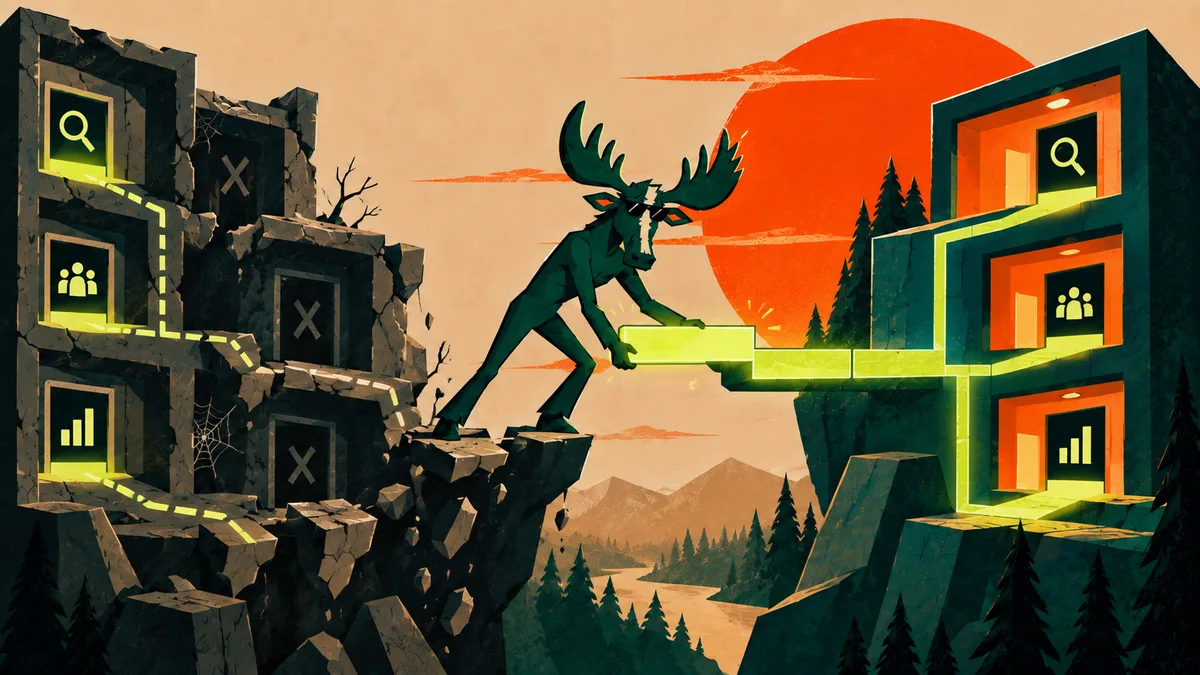
Preserve the business value first; improve the presentation around it.
Baseline the old site, assign new owners, map direct redirects, update internal links, stage the build, and monitor search and lead paths after launch.
Before design
Inventory the assets the current site already owns.
Export indexable URLs, landing-page traffic, queries, backlinks, conversions, forms, analytics, metadata, structured data, media, and internal links. Record pages that rank, earn links, convert, or support a customer journey even when their visual design is dated.
Define the destination
Give every old URL an explicit disposition.
Keep useful URLs when possible. When a URL must change, map it to the closest relevant new owner with a direct permanent redirect. Do not send every retired page to the homepage or chain redirects through several generations.
- Keep and improve
- Merge into a stronger owner
- Redirect to a relevant replacement
- Retire with an intentional not-found response
- Hold for evidence before deciding
Test before launch
Crawl and use the staged site like a customer.
Validate crawl controls, canonicals, metadata, schema, navigation, forms, phone links, analytics, responsive layouts, error states, and performance. Keep staging out of search and remove launch blocks deliberately.
After launch
Watch ownership and leads—not only uptime.
Recrawl redirects, compare index coverage and page queries, inspect 404s, test contact routes, and annotate the change. Expect some fluctuation, but investigate persistent losses by old URL, new owner, query family, device, and lead path.
The MooseRank build model
A custom Next.js website and SEO foundation starts at $2,500.
MooseRank's standard build covers the approved core page set for a local-service business, mobile-responsive design, search-first architecture, priority content work, conversion paths, redirects, launch QA, analytics, Search Console, and the Google Business Profile foundation. Complex applications, large directories, e-commerce, paid software, custom photography, and advanced integrations are scoped separately.
Explore the visible scope on the website and SEO pricing page, or see how the site continues into MooseRank's connected SEO campaign.
As an Long Island website redesign and SEO company, MooseRank builds the website as the operational foundation for search—not as a disconnected design deliverable.
Build the foundation once
Plan the page set, launch requirements, and growth path together.
Bring your services, operating territory, proof, current website, and customer priorities. MooseRank will identify the core build, the conditional pages, and anything that needs separate scope.
Straight answers
Common questions
01Will a website redesign hurt SEO?+
It can when valuable URLs, content, links, metadata, crawlability, or intent ownership are lost. A controlled redesign can preserve and improve those elements, but no process guarantees unchanged rankings.
02Should URLs change during a redesign?+
Keep stable, useful URLs when practical. Change them only for a clear reason, then use direct relevant redirects and update internal links, canonicals, sitemaps, and references.
03Can every old page redirect to the homepage?+
No. Broad homepage redirects often fail to satisfy the old page's intent. Map to the closest relevant replacement or return an intentional not-found response when no substitute exists.
04When should redirects be tested?+
Test the map before launch, immediately after launch, and again as crawlers and users reach old URLs. Check destination relevance, status, chains, loops, and internal links.
05Does MooseRank include redesign migration work?+
The standard build includes content migration and priority rewrites, a redirect map, and launch QA for the approved scope. Complex platforms and integrations may need separate scoping.
Primary sources
Documentation reviewed
- Google Search Central: site moves with URL changes
- Next.js: production checklist
- Google Search Central: page experience
Research note: documentation and the visible MooseRank pricing scope were reviewed September 24, 2026. Framework choice supports implementation; it does not guarantee rankings, leads, accessibility conformance, security, or performance without appropriate design, content, testing, deployment, and maintenance.

About the author
The Moose
The Moose is the Founder of MooseRank and writes about SEO strategy, AI search visibility, website systems, and the evidence businesses should use to make better search decisions.
Meet The Moose and the MooseRank system