
The short answer
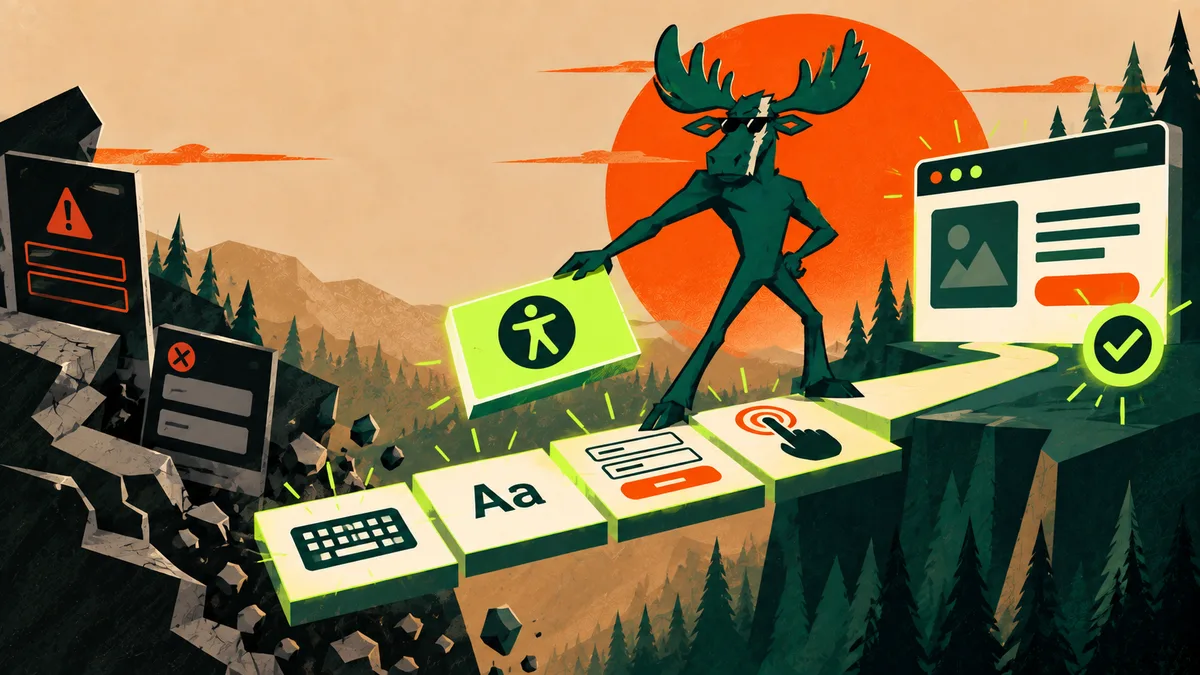
Design access into structure, content, interaction, and maintenance from the start.
Use semantic HTML, keyboard operation, visible focus, sufficient contrast, meaningful alternatives, labeled controls, useful errors, adaptable layouts, and human testing.
Start structurally
Use native semantics and a meaningful reading order.
Headings should describe the hierarchy, landmarks should identify major regions, links and buttons should use the correct element, and the source order should remain meaningful when visual styles change. Add ARIA only where native HTML cannot express the interaction.
Support more than a mouse
Make navigation and controls work by keyboard and touch.
Visible focus, logical order, adequate targets, non-trapping overlays, controllable motion, and clear states help many users. Test menus, accordions, dialogs, forms, and sticky elements through the complete task.
Make meaning available
Use readable language, contrast, alternatives, and instructions.
Write descriptive headings and links, provide useful text alternatives for meaningful images, caption relevant media, preserve zoom and reflow, and avoid using color alone to communicate status.
Protect the lead path
Label controls, explain requirements, and make errors recoverable.
Associate visible labels with inputs, state required formats before failure, group related fields, preserve valid entries, identify the affected control, and confirm successful submission. Automated tests can help find issues, but human and assistive-technology testing remain necessary.
The MooseRank build model
A custom Next.js website and SEO foundation starts at $2,500.
MooseRank's standard build covers the approved core page set for a local-service business, mobile-responsive design, search-first architecture, priority content work, conversion paths, redirects, launch QA, analytics, Search Console, and the Google Business Profile foundation. Complex applications, large directories, e-commerce, paid software, custom photography, and advanced integrations are scoped separately.
Explore the visible scope on the website and SEO pricing page, or see how the site continues into MooseRank's connected SEO campaign.
As an Long Island accessible website and SEO company, MooseRank builds the website as the operational foundation for search—not as a disconnected design deliverable.
Build the foundation once
Plan the page set, launch requirements, and growth path together.
Bring your services, operating territory, proof, current website, and customer priorities. MooseRank will identify the core build, the conditional pages, and anything that needs separate scope.
Straight answers
Common questions
01Does a small business website need to be accessible?+
Accessibility improves equal use and may relate to legal obligations that vary by jurisdiction and context. Obtain qualified legal guidance for compliance questions; do not rely on a plugin or this article as legal advice.
02Can an accessibility overlay make a website compliant?+
An overlay cannot replace accessible structure, content, interactions, and testing. Evaluate any tool critically and fix underlying barriers.
03What standard should a website follow?+
WCAG is the widely used technical reference. The applicable level or legal requirement depends on jurisdiction and context, so seek qualified guidance for formal compliance decisions.
04Can automated testing find every accessibility problem?+
No. Automation catches some detectable patterns. Keyboard, screen-reader, zoom, reflow, cognitive clarity, and real task testing require human evaluation.
05Does Next.js guarantee accessibility?+
No. The framework can support semantic components and production checks, but the implementation, content, interaction design, and testing determine accessibility.
Primary sources
Documentation reviewed
- W3C WAI: Web Content Accessibility Guidelines
- W3C WAI: page structure tutorial
- W3C WAI: accessible forms
- W3C WAI: evaluating web accessibility
Research note: documentation and the visible MooseRank pricing scope were reviewed September 24, 2026. Framework choice supports implementation; it does not guarantee rankings, leads, accessibility conformance, security, or performance without appropriate design, content, testing, deployment, and maintenance.

About the author
The Moose
The Moose is the Founder of MooseRank and writes about SEO strategy, AI search visibility, website systems, and the evidence businesses should use to make better search decisions.
Meet The Moose and the MooseRank system